

How long does equipment financing take? For most deals, the real answer is anywhere from a day to a few business days, depending on how quickly all parties involved move. The lender’s side of the process is often the fastest part. What slows deals down most is documentation, and that’s something you control entirely.
Here’s a realistic look at how long equipment financing takes, what actually drives the timeline, and how to make sure your deal moves as quickly as possible.
The single biggest factor in how quickly equipment financing gets done is how organized your file is before you apply. A clean, complete application with supporting documents ready moves through underwriting quickly. An incomplete one creates back-and-forth that stretches the timeline in ways that have nothing to do with the lender’s decision speed.
The two documents that matter most for most deals are a copy of the invoice or equipment listing and your most recent three months of business bank statements. Bank statements aren’t always required depending on the size of the deal and the strength of the application, but having them ready means you’re never the reason a deal slows down. Coming in prepared with both tells the underwriter exactly what you’re buying and confirms that your business has the cash flow to support the payment.
First Business Bank’s guide to financial statements for equipment financing makes the point directly: well-prepared applications with complete financial information typically receive faster decisions. For application-only deals, approvals can come in under two hours once a complete file is submitted.
One thing that affects the equipment financing timeline more than most buyers realize is whether the equipment carries a title.
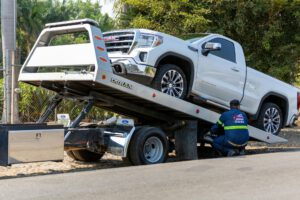
Titled equipment includes trucks, trailers, commercial vehicles, and anything that must be registered through a state DMV. When you finance a titled asset, the lender has to verify the title is clean, confirm there are no existing liens on the vehicle, and in many cases process a lien notation on the title itself before funds can be released. That title work takes time, and in some states it involves additional forms, notarization, or even a physical inspection.
Non-titled equipment includes most construction machinery, manufacturing equipment, forklifts, and other assets that don’t go through state DMV registration. For these assets, the lender secures their interest through a UCC filing rather than title work. As Keystone Equipment Finance explains in their guide to titles and UCC filings, without a title, buyers and sellers rely on bills of sale and lender UCC filings as the main documentation of ownership and security interests. That process is typically faster to clear than title transfer because there’s no state agency involved.
If you’re buying used titled equipment, make sure the seller has a clean title in hand before you apply. An existing lien on a title is one of the most common causes of unexpected delays in equipment financing.
Most lenders require proof of insurance before they fund. For titled equipment like commercial trucks and trailers, this means commercial vehicle coverage with the lender named as an additional insured. For non-titled equipment, physical damage coverage is typically required with the same lender designation.
The funding step often waits on the insurance certificate, not the approval. If you haven’t thought about coverage yet when the approval comes through, you’re adding at least a day or two while you shop for a policy, bind coverage, and get the certificate of insurance issued with the lender’s name on it.
The move is to loop in your insurance agent before you even apply. Give them the equipment details, the approximate financing amount, and a heads-up that you’ll need a certificate naming the lender once you have approval. When the approval lands, the certificate can follow within hours instead of days.
For a well-prepared buyer, here’s what the equipment financing process typically looks like in practice.
Prequalification can happen in minutes with no hard credit pull. It gives you a general picture of your approval range and what your payment structure might look like before you’ve committed to anything.
Full application and underwriting is where most of the time is spent. With a complete file (invoice or listing, bank statements, and business information), underwriting can move in 24 to 48 hours for clean deals. Deals that need more review, whether because of credit, time in business, or the nature of the equipment, may take a few additional days.
Approval and documentation is fast once you’re approved. The lender sends the financing agreement, you review and sign, and the deal moves to funding.
Funding is the final step and usually the step most affected by outside factors. For titled equipment, funding waits on clean title and insurance. For non-titled equipment, it waits on insurance. If both are ready when the approval comes through, funding can happen the same day or the next.
Beyond documentation and title work, a few other factors can extend the how long equipment financing takes conversation.
Newer businesses may require more review time. If your business is under two years old, the underwriter may need additional context from your bank statements and cash flow before getting comfortable with the deal.
Specialty or unusual equipment sometimes requires additional collateral review. Lenders think about resale value and market demand when evaluating equipment, and assets in niche categories with limited secondary markets may take longer to get through underwriting.
Larger deal sizes naturally attract more scrutiny. As the transaction size grows, lenders may require a fuller financial package beyond bank statements — business tax returns, a profit and loss statement, or a balance sheet. Having those documents ready ahead of time means you’re not scrambling to pull them together after the approval conversation has already started.
Unresponsive communication extends timelines more than any other single factor. If the underwriter asks a question or needs a document and it takes two days to get a response, two days gets added to the timeline. Deals that “took forever” often just had slow response times on both ends.
If you’re trying to put equipment into service before December 31st to capture the Section 179 deduction for 2026, the equipment financing timeline becomes a planning problem, not just a process question.
Equipment has to be operational in your business before year-end for the deduction to apply. That means you need financing approved, title cleared (if applicable), insurance bound, and the equipment delivered and running before the calendar flips. Each of those steps takes time, and they don’t all happen simultaneously.
The businesses that miss the Section 179 window usually don’t miss it because they couldn’t get approved. They miss it because they started the process in mid-December and ran out of room for the normal delays that come with any equipment deal. Starting the conversation now gives you the cushion to absorb those delays without losing the deduction.
The fastest way to understand how long your specific equipment financing deal will take is to start the process. Prequalification is quick, there’s no hard credit pull, and it tells you immediately what your approval looks like and what documents you’d need for a full application.
TrueCore Capital works with businesses across industries on equipment financing deals of all sizes. If cash flow is part of the picture alongside the equipment, same-day working capital is worth looking at as well.
Find out what you qualify for today. Give us a call at (805) 422-7342 or submit a contact form below to get started — no hard pull, no pressure.



 July 5, 2024
 July 5, 2024
 July 5, 2024


 by Augustine Sung