

Most of the content out there about commercial truck financing talks to the single-unit buyer — the owner-operator picking up their first semi, or the contractor adding one dump truck to their operation. That’s a perfectly valid starting point.
But what happens when you’re ready to scale? What changes when you’re not buying one truck, but two, four, or ten?
Fleet truck financing is its own animal. The lender looks at the deal differently. The documentation gets heavier. The approval process is more layered. And the mistakes you can make — if you walk in unprepared — get more expensive.
This guide breaks down what actually changes when you go from a single-unit deal to a fleet purchase, and what you need to do differently to get it funded.
There’s no universal definition of when a deal becomes a “fleet deal,” but most commercial lenders start treating it differently once you’re financing three or more units at once. Some draw the line at two.
The reason isn’t arbitrary. The U.S. trucking industry is massive — according to the U.S. Department of Transportation, as of June 2025 there were nearly 580,000 active motor carriers registered with the FMCSA, each owning or leasing at least one truck. Behind every one of those operations is a financing decision that shaped how the fleet was built. A fleet deal — multiple assets, multiple moving parts — requires a different underwriting approach than a clean, single-unit application.
For lenders, a fleet deal raises more questions. Are all the units going to the same location? Are they the same truck type? Is this an expansion of an existing fleet or a startup build-out? Is there enough revenue to support payments on all the vehicles simultaneously? Those questions shape how the deal gets structured.
Here’s what changes when you move from one truck to several:
1. Your financials get more scrutiny.
A single-unit deal often hinges heavily on credit score and a few bank statements. A fleet deal pulls the lender deeper into your business finances — profit and loss statements, tax returns, accounts receivable, and sometimes a cash flow projection. They want to know your operation can carry multiple payments at once, not just one.
2. The collateral picture gets more complex.
When a lender finances one truck, the collateral math is simple. Fleet deals involve multiple assets of potentially different ages, makes, mileages, and values. Lenders assess residual value and depreciation across the full package, and that evaluation affects both your approval and your rate.
3. Documentation increases significantly.
Expect to provide more: full fleet specs for each unit, purchase invoices or auction sheets, proof of insurance coverage for all vehicles, and in some cases, driver information if your operation requires CDLs. Coming in organized makes a real difference at this level — something we’ve covered in our equipment financing pre-approval checklist.
4. Deal structure becomes a negotiation.
With single units, the terms are fairly standardized. Fleet deals often involve more back-and-forth — term length, balloon payments, step-up payment structures for seasonal operators, and whether you’re financing all units under one agreement or staggered across separate notes. Knowing what you want going in helps.
When a lender underwrites a fleet truck financing deal, they’re running the same basic credit assessment they always do — but scaled up and with more context required.
Time in business. A startup operation buying five trucks at once is a much harder conversation than an established carrier with three years of financials adding to an existing fleet. If you’re early-stage and trying to build a fleet, expect a higher down payment requirement and more restrictive terms. It doesn’t mean it can’t be done — it just means the structure changes.
Revenue and cash flow. Fleet lenders want to see that your monthly revenue comfortably covers your projected payments, with room left over. They’re not just asking “can you afford it today” — they’re modeling whether you can sustain it if a truck goes down for a week or a slow season hits. This matters more than ever given the market backdrop: the American Trucking Associations projects truck volumes will grow 1.6% in 2025 and climb toward nearly 14 billion tons by 2035, but that long-term trajectory doesn’t insulate individual operators from short-term freight softness. Lenders know this, and they’ll stress-test your cash flow accordingly.
Comparable debt history. This is one of the most underestimated factors in a fleet deal. Lenders want to see that you’ve successfully carried debt at a similar scale before — previous commercial loans, equipment notes, or vehicle financing managed responsibly over time. If you’re asking for $400,000 across four trucks but the largest loan you’ve ever held was $40,000, that gap will raise questions. It doesn’t have to be an exact match, but your track record should be in the same ballpark as the ask. If your borrowing history is thin or skews toward smaller consumer debt, address it proactively in your application rather than letting the underwriter find it on their own.
The nature of the fleet itself. Are these identical trucks for the same route, or a mixed bag of vehicle types? Lenders are more comfortable when the fleet makes operational sense. Buying five of the same work truck for a known contract is an easier story than five different units for a business plan that’s still theoretical.
Your relationship with the industry. This matters more in trucking than in most other equipment categories. The freight market has real cycles — periods of contraction followed by recovery — and lenders who understand that dynamic will underwrite your deal differently than one that doesn’t. Working with a lender who actually knows commercial vehicles can make a significant difference in both approval odds and the terms you walk away with. Take a look at our trucks and commercial vehicles financing page to see how we approach these deals.
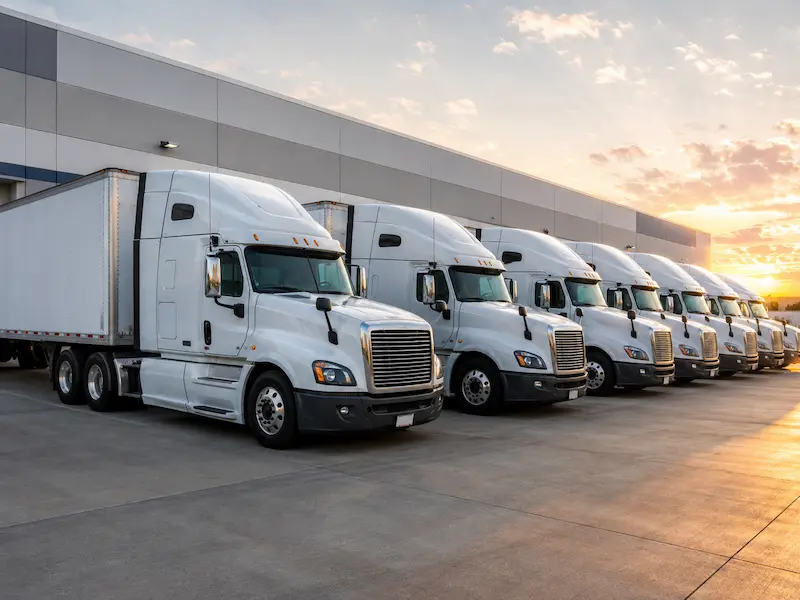
There’s more than one way to finance a fleet, and the right structure depends on your situation.
Individual notes per unit. Each truck gets its own loan. This gives you flexibility — you can pay one off early, sell a unit without affecting the rest, and manage each asset independently. The downside is more paperwork and potentially different rates per unit.
Blanket fleet loan. One loan covers all units. Easier to manage administratively, and sometimes better for negotiating favorable terms at volume. The trade-off is that all units are cross-collateralized, so a problem with one affects the whole agreement.
Fleet leasing. Some operators, especially those running delivery or service vehicles with predictable turnover cycles, prefer leasing. This works well when you want to cycle equipment frequently or preserve capital for other parts of the business. The SBA notes that lower down payments and flexible overhead requirements are among the hallmarks of well-structured commercial financing — and leasing often delivers exactly that for operations that don’t need to own the asset outright.
Staggered financing. Rather than buying everything at once, some operators finance in phases — two trucks now, two more in six months. This can be a smart play when you’re growing toward a known need rather than filling it all at once. It also gives you time to build a payment history before the next round.
Applying before your financials are clean. Fleet underwriting is thorough. If your bank statements show irregular deposits, large unexplained cash withdrawals, or back-to-back NSFs, that will slow or kill the deal. Prepare a few months before you apply.
Treating it like a single-unit deal. Walking into a fleet application with the same documentation you’d bring for one truck wastes everyone’s time. Come prepared with full fleet specs, organized financials, and a clear picture of how the operation works.
Underestimating the down payment. Fleet deals often require more skin in the game, particularly for newer businesses or mixed-use fleets. Be ready for 10–20% down depending on the deal, and know that putting more down usually gets you better terms.
Not addressing the comparable debt gap. If your borrowing history doesn’t come close to matching the size of your fleet ask, don’t ignore it — explain it. A strong business narrative, solid revenue documentation, and a larger down payment can all help bridge that gap. Going in silent on it won’t.
Applying to lenders who don’t work in commercial trucks. A bank that does mostly real estate or personal loans doesn’t understand the seasonal revenue swings, the freight cycle, or the collateral dynamics of a commercial vehicle fleet. You want a lender who speaks your language.
The scale of the commercial trucking market makes fleet decisions consequential. Trucking accounts for roughly 72.5% of all freight tonnage in the United States annually, and the fleets that operate in that space carry real economic weight. At fleet scale, having the right financing structure isn’t optional — a deal done right keeps your capital in the business. Done wrong, it ties you to payment terms that strangle your cash flow before you can build momentum.
If you’re evaluating a multi-unit truck purchase and want to understand what your deal could look like, we’re here to help you think through it — before you apply, not after. TrueCore Capital works with operators across a wide range of fleet types and business stages, and we’re built for the kind of deals that don’t fit a generic bank’s checkbox.
📞 Give us a call at Truecore Capital today at (805) 422-7342 or fill out a quick application below to discuss your fleet truck financing needs and see how we may be able to help structure the right deal for your business.
Sources:
• American Trucking Associations (ATA), “Economics and Industry Data,” [https://bid.fastline.com/auctions/9631/fastli10069].
• American Trucking Associations (ATA), “Truck Freight to Bounce Back in 2025, ATA Projects,” [https://www.trucking.org/news-insights/truck-freight-bounce-back-2025-ata-projects].
• U.S. Small Business Administration, “Loans,” [https://www.sba.gov/funding-programs/loans].
• Market Data Forecast, “North America Heavy Duty Trucks Market Report,” [https://www.marketdataforecast.com/market-reports/north-america-heavy-duty-trucks-market].



 July 5, 2024
 July 5, 2024
 July 5, 2024


 by Augustine Sung